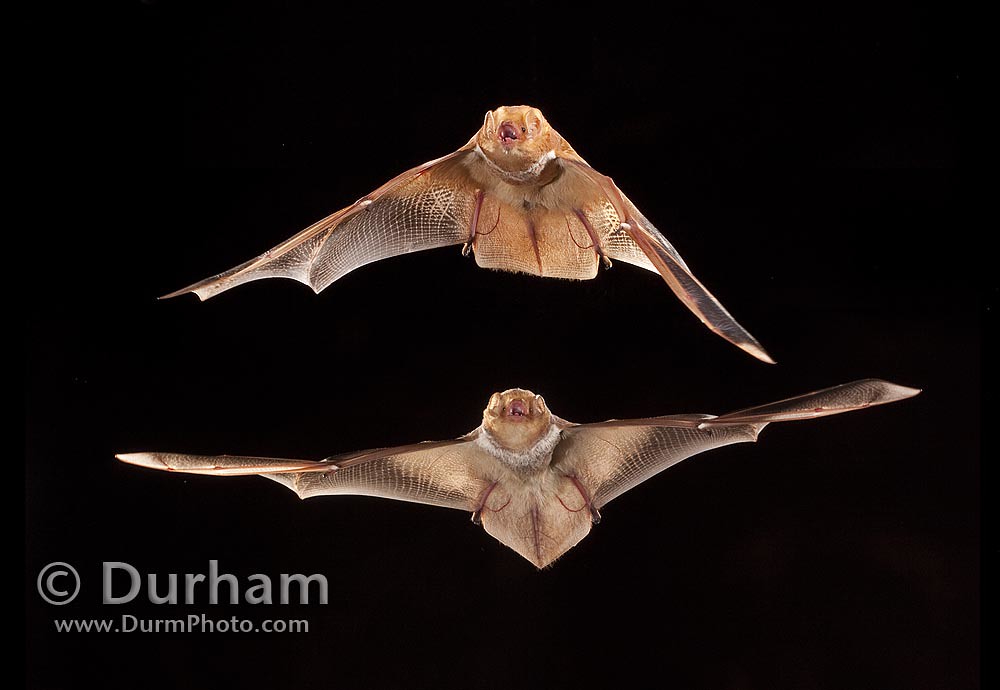
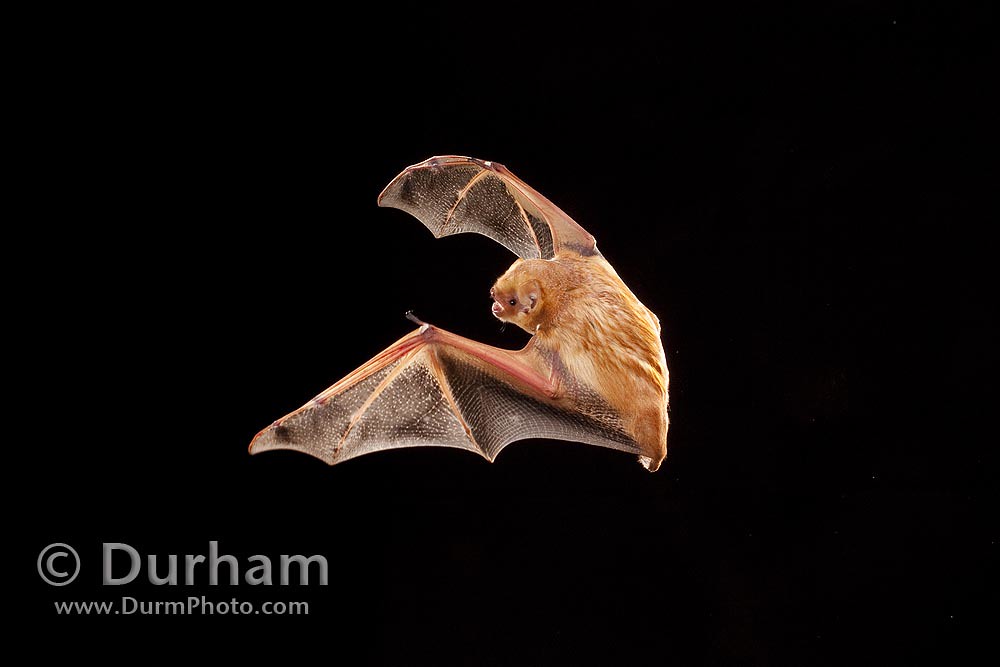
Male and female bats often have the same physical appearance (to human eyes at least). However the eastern red bat mentioned in the previous post is noted for having an easy clue for gender - the males tend to be more red than the females.
This can be a subtle difference, or a dramatic difference. One biologist I spoke to felt that the male bats probably develop a deeper red as they mature and get older.
male (top) and female eastern red bat (Lasiurus borealis)
This particular bat is not really uncommon, but I have been looking to photograph one for years and years. Lovely, graceful, and not terribly friendly! Like all bats they prefer to be left to themselves when it comes to human interaction.
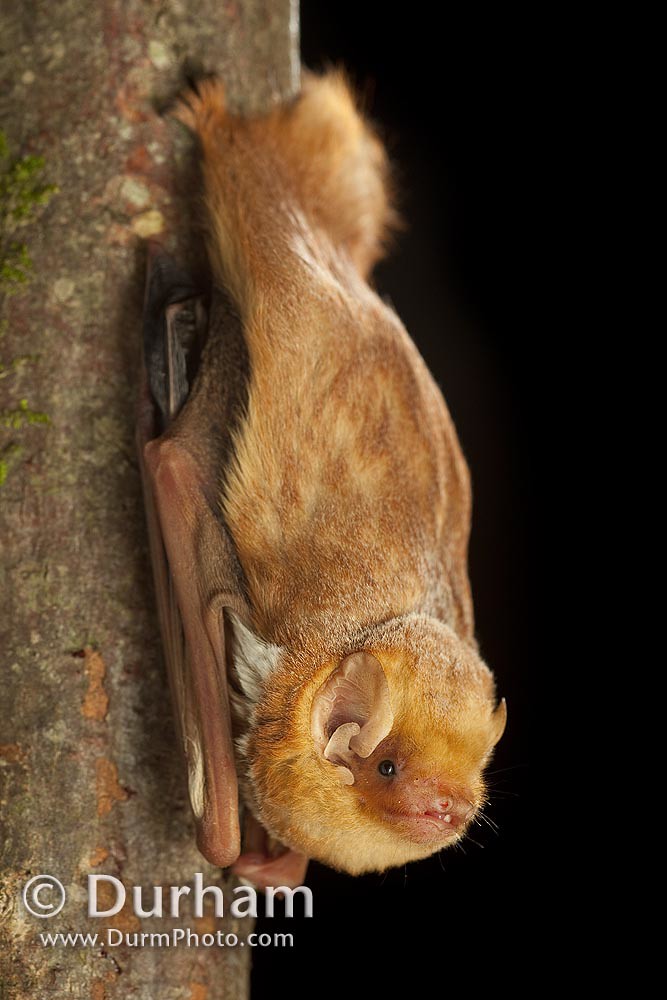
The image of the red bat roosting on a tree limb was especially hard to obtain. This little male would land for about three seconds (just enough time to barely get into focus) and then take of before I could press the shutter!
eastern red bat (Lasiurus borealis) roosting on a tree limb
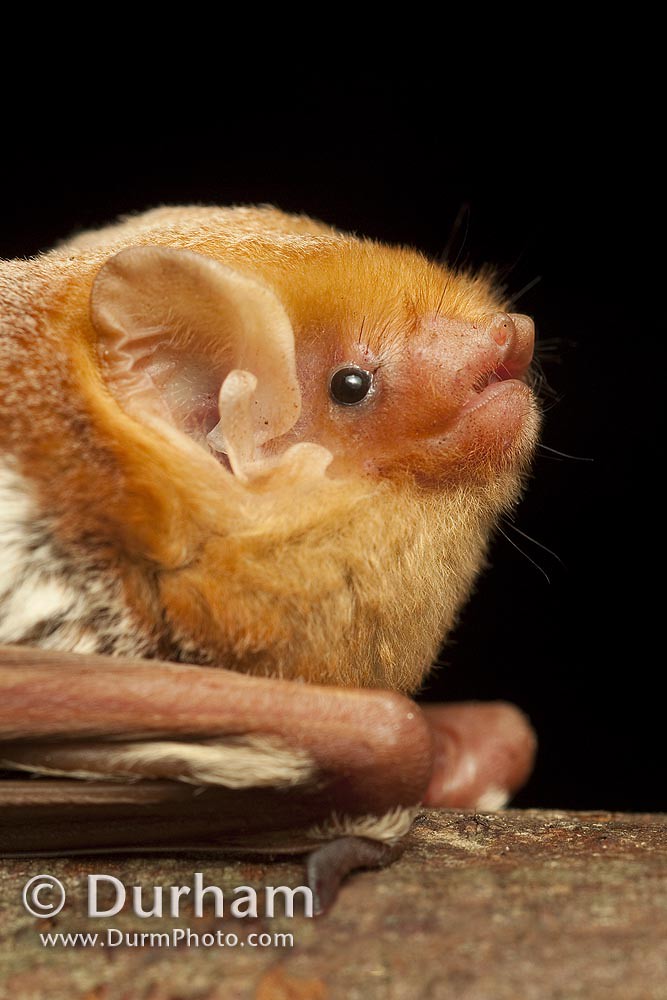
portrait of an eastern red bat (Lasiurus borealis)
As I get older it seems I have less time to accomplish anything, or perhaps my perception of time is shifting. This might also be because video is becoming a more prominent part of my work.
I might not have much time, but at least my time lapse work is showing some promise...
Coming from the west, where our forests are filled with bird song and the rhythmic chirping of crickets - I had forgotten how loud the forests in the south can be in Summer. At night, the cicada where especially loud - and I shot a few video scenes to capture the ambient audio...
I have been in George to participate in the Bat Blitz, sponsored by the Southern Bat Diversity Network (SBDN). We headquartered at Fort Mountain State Park in the Chattahoochee National Forest. It had been many years since I had been to Georgia, and I took the time to hike around parts of the park to see the landscape during daylight.
Trees and granite stones in Fort Mountain State Park in the Chattahoochee National Forest, Georgia.
a href="http://www.flickr.com/photos/oregonwild/4892790212/" title="Chattahoochee National Forest by Michael Durham, on Flickr"> Trees and granite stones in Fort Mountain State Park in the Chattahoochee National Forest, Georgia.
The view near the top of Fort Mountain State Park, part of the Chattahoochee National Forest, Georgia.
Not long before my grandfather died, he made a point of telling me about some of our Cherokee bloodlines. His father was full blooded Cherokee, and his mother was white, which of course, makes him half Cherokee.
He told me about the Trail Of Tears - the forced removal of the Cherokee from their homelands in parts of the south in 1836 - 1839. Thousands of Cherokee died along the trail, as they were moved to the Indian Nations. Their properties were stolen by decree, and those who refused to cooperate were placed in jail or beaten into submission.
I found myself on the way to Chatsworth Georgia recently, and noted with some surprise that I was on highway marked in memory of the Trail Of Tears. It was along one of the routes used. It seemed so long ago, and so far away when my grandfather spoke of it. But here was a reminder, and it made me think of that long ago conversation with my grandfather.
trail of tears highway marker
Below is a clip from the Clint Eastwood movie "The Outlaw Josie Wales" where Chief Dan George portrays Lone Wadie, a Cherokee who was forced to move to the Indian Nations. Half way in he speaks of the Trail Of Tears.
I have been working in high-definition video for the past four years, but the remarkable Canon 5d Mk II and 7D have allowed me to shoot much more while in the field. Shoots that were strictly still photo, can now also be HD video without much additional equipment.
Of course, it has been possible to shoot video with a regular old still camera if one chooses to hook up an intervalometer and leave a camera in place for many hours if not days. The video below was shot with a standard issue Canon rebel purchased used off of Craigslist. I stuck it out in the middle of the high-desert in Washington and left it unattended for nearly two days while I was photographing bats.
Sometimes you get lucky with weather and atmosphere. Sometimes you don't.
The high-speed camera is cool because it can record things beyond what the human eye can perceive. I remain convinced that there are some wonderful and amazing things that happen at every moment, but proceed unnoticed because of perception, or lack there of.
Behold two long-legged bats in hot pursuit of one another. This is not the best image, but it records something remarkable. Note how they are contorting their bodies as they proceed at full speed with what appears to be chase and evasion.
Two long-legged bats (Myotis volans) exit Pond Cave, one in hot pursuit of the other