Photo Durham Logo - Link to Home Page
Showing posts with label bats. Show all posts

Friday, February 13, 2009

Seminole Bat (Lasiurus seminolus)

With the wonderful help of Leigh Stuemke, I went out into the wilderness of East Texas and photographed seminole bats. Like so many bats, there are many mysteries about the life habits of seminole bats, but they are beautiful animals with striking features.

92408TTb-749

92408TTb-605

It was a warm and humid evening with fireflies and frogs. A cottonmouth was curled up next to the pond where we set-up the gear. This was only a few days after hurricane Ike devastated Galveston, and we had to navigate around downed trees to make our way into the Stephen F Austin Experimental forest.

I can only wonder how such a small creature could survive a monster storm, tucked into some small crevice, or under the bark of a swaying tree.

92408TTb-614

Bats are quick and lovely, and I never fail to be amazed by them.


Wednesday, July 02, 2008

Silver-haired bat (Lasionycteris noctivagans)

I have worked with many different species of bats through the years and there are some species that can be challenging to distinguish from one another. Primarily, the small myotis species can look very similar - however, as I spend more time with bats it becomes clear that most are uniquely interesting (such as my favorite the spotted bat). One such bat is the silver-haired bat:

61008BT-10-1
Silver-haired bat (Lasionycteris noctivagans)


Their name is derived from the frosty patch of pelage that runs along their back. There can be considerable variation in adult fur color and the "silver hair" is most visible in the darker individuals.

61008BT-51
Silver-haired bat (Lasionycteris noctivagans)


I have come across these bats on many occasions, but have found it frustrating to try and get good images of them. Mostly, I think, its their contrarian personality. When I try to get portraits they fly away. When I try to get flight shots, they decide to remain on their perch. No other bat has ever given me such a difficult challenge when trying to get images.

Yet they have a lot of personality - and an expressive face.

61008BT-27
Silver-haired bat (Lasionycteris noctivagans)


61008BT-27-1
Silver-haired bat (Lasionycteris noctivagans)


I finally found a silver-haired bat that was a willing subject - thanks to Barb Ogaard, a bat specialist and rehabilitator. This little bat was a fat, happy, and just getting out of rehab. And she was more than willing to exercise her wings in preparation for her upcoming release back into the wild.

61008BT-41

Silver-haired bat (Lasionycteris noctivagans)

Monday, November 05, 2007

A Rare And Extraordinary Creature – Euderma maculatum, spotted bat

Years ago I heard a biologist describe an encounter they had with a spotted bat, and I remember how impressed I was by the sense of wonder and awe that I heard in that description. Perhaps it is necessary to spend one's professional life in the study of bats to get a sense of the mythical status surrounding these creatures, but I was immediately impressed with the description, and how unique and rare the spotted bat is among bats.

Spotted bats were once considered to be the rarest of North American mammals. Up until the 1990's very few had ever been collected, and most of these were dead or mummified remains. A few live spotted bats were seen, one at the entrance to a cave. However, it turns out that spotted bats are one of the few bats who's echolocation call can be easily heard by the human ear. Once this fact was discovered, biologists eventually found that, while they are still not a common species, they can be detected in many habitats where their presence was completely unknown before.

They fly high and fast in the darkest hours of the night, and they have an uncanny ability to avoid being captured using specialized techniques commonly employed by biologists who study bats. To this day, capturing one is still a rare event, and there are bat biologists who, despite years in the field, have never seen one.

I am still slightly stunned that I was along when a graduate student, working near the rim of the Grand Canyon in Arizona, caught four spotted bats over the course of two nights - even though he was trying to capture an entirely different species. This gave me a unique opportunity to get some detailed photographs of the the bat.

110407SPb-151 copy
spotted bat (Euderma maculatum)


Below you can see the pattern of three distinctive spots that give the bat its name.

110407SPb-154 copy
spotted bat (Euderma maculatum)


110407SPb-171 copy
spotted bat (Euderma maculatum)


A photograph cannot really show the amazing amount of character these bats have.

110407SPb-59 copy
spotted bat (Euderma maculatum)


Bats are still largely mysterious creatures - many of their habits and roosting sites remain completely unknown. However, technology is just now giving biologists the ability to use miniature transmitters to track these tiny mammals. The female bat, seen in these images, was lactating - meaning that she had a pup hidden away somewhere. Because this capture presented a rare opportunity to track a mother spotted bat, she was outfitted with a transmitter and set free (the transmitter will fall off after a few days).

The next day a plane was chartered, and Grand Canyon National Park gave special permission to fly into the Canyon with radio telemetry gear to see if the day roost of this bat could be located. After many hours of searching, the bat's location was detected, 17 miles from the capture site the night before, in a crevice in one of the sheer cliff walls of the Grand Canyon. Presumably, she returned to nurse her young pup after a night of hunting insects in the warm Arizona night.

Saturday, June 23, 2007

Chasing Bats In The Ochocos

All last week I was out working with the Forest Service and BLM bat survey teams in the Ochoco National Forest.

61807BT-52-Edit copy
The bat crew at work.

Bats are very fast, nocturnal flyers that can be seen all around the northwest at dusk, but determining species can be very, very challenging. The biologists that specialize in bats will typically catch a few bats, measure ears and wing arm length, record their vocalizations and do their best to determine species. The bat is released a few minutes later. They will collect this information for years to try and identify population trends, and measure how healthy bat colonies are.

Photographing bats can be quite challenging as well, but between the capture and the recording of data, I will spend a few minutes to try and photograph the bat, and if I am lucky - I can get a cool photo or two. The detail I am able to record of the bats in flight can actually help researchers identify the bat species, and the biologists use the images as part of their reports and published literature.

62007BT-25-Edit copy
A western long-eared bat (Myotis evotis)

62007BT-4-Edit copy
Yuma myotis

In the time exposure image below, a light is temporarily placed on the bat so that researchers can record the high-frequency calls of the bat. The light will fall off in a few minutes.

62007BT-31-Edit-2 copy

Tuesday, October 31, 2006

Not So Scary

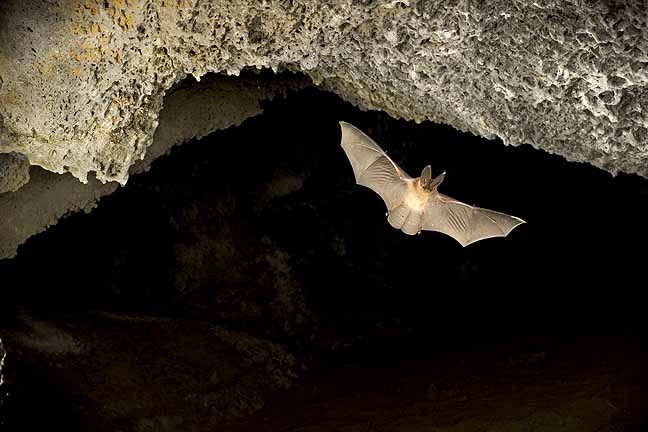
Halloween has arrived, and in honor of the occasion, I am posting a few photos of one of my favorite bats from Oregon - the townsend's big-eared bat. I think the big ears make this bat especially charming. I made these images in a cave complex near Fort Rock.


Subscribe in a reader

Enter your email address:

Delivered by FeedBurner

Details About Me

Portland, Oregon, United States
Husband, Father, Student Of Natural History, Photographer