western juniper tree (juniperus occidentalis)
Showing posts with label night. Show all posts
Saturday, April 17, 2010
Western Juniper Tree (juniperus occidentalis) At Night
Twisted and old, this beautiful juniper is like a sculpture. I love to photograph trees at night because it removes the tree from the complexity of its surroundings.

western juniper tree (juniperus occidentalis)
Sunday, March 28, 2010
Southeastern Myotis (Myotis austroriparius)
When people hear that I work with bats frequently, they usually assume that I have to go into a lot of caves. And while bats are often cave dwellers, they are also at home in a variety of other habitats.
For instance, below a southeastern myotis emerges from a tree hollow in Central Texas at dusk.

Southeastern Myotis (Myotis austroriparius) emerging from tree hollow

Southeastern Myotis (Myotis austroriparius) detail
Bats are usually content to find a tiny place they can squeeze into, where southern exposure keeps the environment warm and they feel safe.

Southeastern Myotis (Myotis austroriparius)
For instance, below a southeastern myotis emerges from a tree hollow in Central Texas at dusk.
Southeastern Myotis (Myotis austroriparius) emerging from tree hollow
Southeastern Myotis (Myotis austroriparius) detail
Bats are usually content to find a tiny place they can squeeze into, where southern exposure keeps the environment warm and they feel safe.
Southeastern Myotis (Myotis austroriparius)
Labels:
bat,
Myotis austroriparius,
night,
night forest,
nocturnal,
Southeastern Myotis,
tree hollow
Friday, February 13, 2009
Seminole Bat (Lasiurus seminolus)
With the wonderful help of Leigh Stuemke, I went out into the wilderness of East Texas and photographed seminole bats. Like so many bats, there are many mysteries about the life habits of seminole bats, but they are beautiful animals with striking features.


It was a warm and humid evening with fireflies and frogs. A cottonmouth was curled up next to the pond where we set-up the gear. This was only a few days after hurricane Ike devastated Galveston, and we had to navigate around downed trees to make our way into the Stephen F Austin Experimental forest.
I can only wonder how such a small creature could survive a monster storm, tucked into some small crevice, or under the bark of a swaying tree.

Bats are quick and lovely, and I never fail to be amazed by them.
It was a warm and humid evening with fireflies and frogs. A cottonmouth was curled up next to the pond where we set-up the gear. This was only a few days after hurricane Ike devastated Galveston, and we had to navigate around downed trees to make our way into the Stephen F Austin Experimental forest.
I can only wonder how such a small creature could survive a monster storm, tucked into some small crevice, or under the bark of a swaying tree.
Bats are quick and lovely, and I never fail to be amazed by them.
Labels:
bats,
Lasiurus seminolus,
night,
nocturnal,
seminole bat
Wednesday, July 02, 2008
Silver-haired bat (Lasionycteris noctivagans)
I have worked with many different species of bats through the years and there are some species that can be challenging to distinguish from one another. Primarily, the small myotis species can look very similar - however, as I spend more time with bats it becomes clear that most are uniquely interesting (such as my favorite the spotted bat). One such bat is the silver-haired bat:

Silver-haired bat (Lasionycteris noctivagans)
Their name is derived from the frosty patch of pelage that runs along their back. There can be considerable variation in adult fur color and the "silver hair" is most visible in the darker individuals.

Silver-haired bat (Lasionycteris noctivagans)
I have come across these bats on many occasions, but have found it frustrating to try and get good images of them. Mostly, I think, its their contrarian personality. When I try to get portraits they fly away. When I try to get flight shots, they decide to remain on their perch. No other bat has ever given me such a difficult challenge when trying to get images.
Yet they have a lot of personality - and an expressive face.

Silver-haired bat (Lasionycteris noctivagans)

Silver-haired bat (Lasionycteris noctivagans)
I finally found a silver-haired bat that was a willing subject - thanks to Barb Ogaard, a bat specialist and rehabilitator. This little bat was a fat, happy, and just getting out of rehab. And she was more than willing to exercise her wings in preparation for her upcoming release back into the wild.

Silver-haired bat (Lasionycteris noctivagans)
Their name is derived from the frosty patch of pelage that runs along their back. There can be considerable variation in adult fur color and the "silver hair" is most visible in the darker individuals.
Silver-haired bat (Lasionycteris noctivagans)
I have come across these bats on many occasions, but have found it frustrating to try and get good images of them. Mostly, I think, its their contrarian personality. When I try to get portraits they fly away. When I try to get flight shots, they decide to remain on their perch. No other bat has ever given me such a difficult challenge when trying to get images.
Yet they have a lot of personality - and an expressive face.
Silver-haired bat (Lasionycteris noctivagans)
I finally found a silver-haired bat that was a willing subject - thanks to Barb Ogaard, a bat specialist and rehabilitator. This little bat was a fat, happy, and just getting out of rehab. And she was more than willing to exercise her wings in preparation for her upcoming release back into the wild.
Silver-haired bat (Lasionycteris noctivagans)
Tuesday, October 31, 2006
Not So Scary
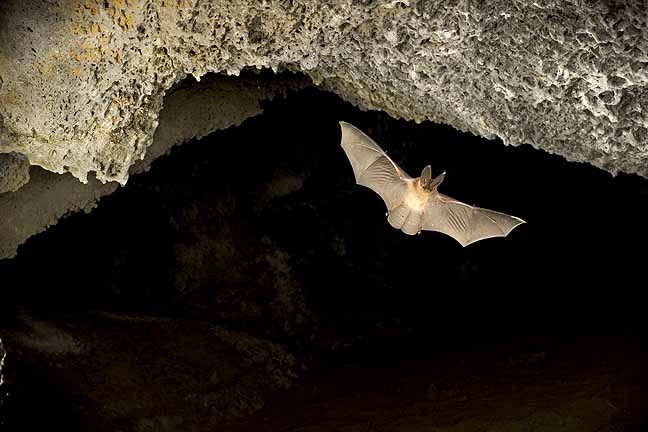
Halloween has arrived, and in honor of the occasion, I am posting a few photos of one of my favorite bats from Oregon - the townsend's big-eared bat. I think the big ears make this bat especially charming. I made these images in a cave complex near Fort Rock.


Subscribe to:
Posts (Atom)
Sites I read
Details About Me
- OregonWild
- Portland, Oregon, United States
- Husband, Father, Student Of Natural History, Photographer